First Troop In San Angelo, Texas - 1911

by Frank T. Hilton
S an Angelo, Texas is part of theConcho Valley Council, BSA.The Council was chartered in 1926 and serves 23 1/2 counties in West Texas. Here is the story of it's first Scout troop.

There has been much debate among Scouters and Scout Professionals concerning when the first Scout troop was organized in this area.  Everyone could agree on who started the first troop and could even agree on how many Scouts (103) were in the troop.  However, they could not agree on when the troop was started.

The date 1910 was perpetuated by news stories that appeared over the years in the San Angelo Standard-Times written by former Scouts, Scouters and Scout Executives starting from 1932 on. Even the story written on September 8, 1942, following the death of the first Scoutmaster here, said "Back about 1910 before the Boy Scouts of America had been organized ..."

A letter received from Samuel H. Crowthers of San Antonio, grandson of Sam Crowther, to this author dated April 4, 1988, said in part "In all my conversations with members of the family, these things are consistent:  1) Received the Silver Beaver Award,  2) Founded the first Scout troop in Texas,  3) Founded the third Scout troop in the United States."  In addition, in a two-page typewritten statement prepared by Reva Terry Crowther about 1970 said "organized a boy Scout troop in 1910.  Only two Scout troops existed in the U.S. at that time.  San Angelo was the third.  These troops were organized under instructions from Lord Baden Powell in England, as the Scout movement in the U.S. had not yet gotten under way."

Many Scouters honestly believed this to be correct, even this author, until research of the San Angelo Standard from 1910 through 1931 revealed another story which is presented here.


Meeting Announced

T he first story to appear in the San Angelo Standard regarding Boy Scouts appeared on Friday evening, July 28, 1911, on page 1, under the headline "BOY SCOUTS WILL BE ORGANIZED SUNDAY."  The sub-title of the story said "MOVEMENT THAT COVERS 44 STATES HAS REACHED ANGELO" and under that it further said "OBJECT IS TO MAKE USEFUL CITIZENS OF THE BOYS - CROWTHER HEADS MOVEMENT."

The story announced a meeting for the purpose of organizing Boy Scouts to be held at 3:30 o'clock Sunday afternoon at the Chamber of Commerce rooms.  The story further said that "Sam Crowther, head of Crowther Hardware Company and president of the public school board, is enthusiastic over the movement and has consented to take the lead, accepting a place as head of the local advisory board."   The story also said "Applications for membership and affiliation cover 44 states and territories ..."

No mention is made in that San Angelo story, or those that followed, throughout 1911 and 1912, about a previous Scout troop in San Angelo.  However, in a story that appeared in The San Angelo Daily Standard on May 3, 1914, page 6, under the banner "ANGELO BOY SCOUT MOVEMENT TO BE REVIVED FOR ENCAMPMENT" said "In 1911 San Angelo boasted a Boy Scout troop of over 100 enthusiastic members and one encampment, a most successful one, through the courtesy of Lee Brothers, was conducted on the latter's ranch, but following this event, which all Scouts will remember as one of the pleasan'est in years, the movement waned and finally died out."

There were other stories that referred to the 1911 date as being when the first Scout troop was organized in San Angelo.


Organizational Meeting

Fifty members signed up for the first Boy Scout troop in San Angelo at its first organizational meeting.  The meeting was held on Sunday, July 30, 1911, 3:30 p.m., in the Chamber of Commerce meeting room located above the Baker-Hemphill Company store, at the corner of Chadbourne and Beauregard.  A number of fathers were present at the meeting.

Harry B. Ogg, bookkeeper and cashier of the business office of the Standard, who had recently been appointed the local Scout deputy and organizer for San Angelo and vicinity, gave a 15-minute talk on Scouting.  He was followed by Sam Crowther, president of the school board, who touched upon many interesting phases of the movement, explaining, among other things, the approximate cost of the uniform and equipment, the necessity for co-operation, the fulfillment of all agreements entered into, the opportunity for helping each other and the world at large, regardless of age, sex, color or condition of those with whom the members came in contact in the daily association at home and in public.

Continuing, he spoke of hikes, outings and other forms of recreation and amusement that would be afforded those who joined from time to time.  One important matter that he called particular attention to was the fact that Scout movement would not permit any interference with school duties or any plans that their parents had laid out for them.  This talk was followed by some remarks by Dr. A. H. Seeley and then Penrose N. Ions, of the firm of Ions & Boulware.

By unanimous consent of all those present, Sam Crowther was elected chairman and Harry D. Ogg secretary of the present movement.   The next Friday night, at 8 o'clock, was selected as the next meeting time to be held at the same place.

Fifty members signed up which was half of the number selected for San Angelo.  Each patrol was to have nine members, one of whom was selected as patrol leader with an older person, a man of mature years preferably, constitute a patrol.  Thus a patrol consisted of ten men.  Ten patrols make a company and ten companies a regiment.  Mr. Crowther and Mr. Ogg were trying to get their full quota of one company, including ten Scoutmasters and ninety boys.


First Patrol Formed

A fter the adjournment of the first meeting of the Scouts, a number of older and larger boys, those crowding the 18 maximum mark pretty closely, got together in the law offices of Cox & Cox in the Trust building and organized the first Boy Scout patrol.

The officers elected for this patrol were: Harry B. Ogg, Scout master; Mark Woodward, patrol leader; Harry Boertsou, secretary.

By the second meeting, held the following Friday, August 4th, eight patrols with a Scoutmaster and patrol leader were announced.  At this meeting Sam Crowther was recognized as the "Head or Chief Scout Master" and that he would preside over the council meeting as chairman ex-officio.


First Patrol Hike

M embers of the Pioneer Patrol No. 1, went on the first hike of the new troop, leaving the city at 6:20 and returning at 11:20 on August 10, 1911.  They hiked to "Four Mile Falls", returning by moonlight after supper and a dip in the river.  They were footsore and weary but happy and determined to repeat the performance at the slightest provocation.

One of the Scoutmasters, Spencer Wells, of the Baker-Hemphill Company, had on display two uniforms and complete outfits for their troop meeting on August 12.  The troop voted to secure the better grade of uniform displayed.

The manuals for the Scouts were to arrive on Friday night, August 18, at which time they planned a troop hike to Leedale.  However, the manuals did not arrive as expected.  A communication from James E. MacGrath, managing director of the movement, with headquarters at New York City stated that a new manual was being issued and would be ready for delivery within the next three or four weeks.


Appointed to National

S am Crowther was appointed National Committeeman of the American Boy Scouts which carried with it one of the honors scattered sparsely over the United States.  This group was not the "Boy Scouts of America" as organized by W. D. Boyce, the Chicago publisher, but a group organized by William R. Hearst, Incorporated in New York, June 24, 1910, as the "American Boy Scout", afterwards changed to "United States Boy Scout."  This may well explain why some Scouters thought that Sam Crowther had obtained the first troop charter from Baden-Powell in England instead of from the Boy Scouts of America.  If the charter was indeed obtained from the American Boy Scout organization, instead of the Boy Scouts of America, it could have well been the first charter of that organization in Texas.

These two groups were not the only Boy Scouts in the U.S.A. at the time.  There were also the "Boy Scouts of the United States," sponsored by the National Highway Protection Association, the "National Scouts of America" organized by Co. William Verbeck, principal of a Military School at Manlius, N.Y. and the "Peace Scouts of California" and the "Y.M.C.A. Scouts."  All of these movements except for the last one, were more or less military in character as was the first Scout
troop in San Angelo.


First Troop Overnight

O n August 25, 1911, ninety-five Scouts departed at 5:30 PM for Concho Vista (Leedale) for an evening's outing and a swim in the Middle Concho River.  The boys rode out in closed top automobiles to Concho Vista which is now part of Mathis Field, west of San Angelo.  The Standard  was published that Thursday evening "a couple of hours" ahead of time so that twenty-one members of the Standard's crew of boys could go on the hike.

Scouts On Hike

Emmett D. Cox, a member of the troop, was to write in 1949 that "The trip to the site was made in threatening weather.  The campfire program was set up while torrents of rain decended on the group huddled about the fire.  "At the word given by Scoutmaster Crowther, an orderly retreat was made to a huge barn where the Lee Brothers housed their registered Hereford stock.

"Yes, we were all registered Herefords and Scouts," Cox said.  The hay had, though, a different appeal to the boys from the one it had to the cattle.  I guess you might say we originated the saying, 'hit the hay' literally.  To make a good initial short-term camp, the Scouts hiked back to town in the rain."

As a matter of fact, the boys "hit the hay" at 10:30 and at 3:30 a.m. the boys were ready to come home.  For two and a half miles the boys, in uncovered autos, were driven through the rain, arriving in San Angelo for breakfast at 6 o'clock Friday morning.

In talking with the widower of one of the "Scouts" in 1988 she, when asked if her husband ever said anything about his experiences in Scouting, said "Oh yes, only one thing.  He told me that when he got home (from the hike to Leedale), he slept for two days and then quit the Scouts!"

Rice Lynn, San Angelo lawyer, and a member of the first troop; recalled this story about the first hike and campout in 1971.  "When they were on the Lee ranch at Tankersley, the rain came with a vengeance.  Two of the Scouts, Maynard Leffel and the late Harold Broome, had jobs in town and decided to start home.

"When they hit Red Arroyo, there was no bridge then -- the boys waded through in water that was shoulder-deep.  Later they voiced wonder that they had made it without being washed downstream.

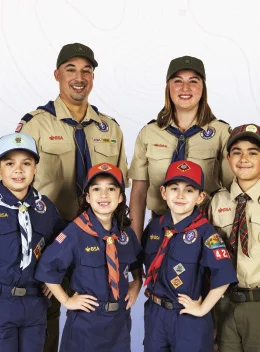
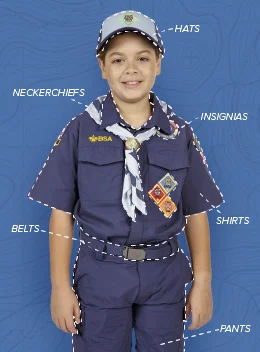
"What that red mud did to the state of their snappy green uniforms probably was drastic.  Broome died some years ago in an automobile accident, and Leffel is ill now, but presumably they were wearing the olive shorts and brimmed hats with the peaked crowns that constituted the first uniforms."


Military Drill

F ollowing the hike to Leedale the troop usually had from forty to fifty boys attend their meeting.  On September 11, 1911, for several nights, the Scouts met at the Riverside armory for drill training under First Lieutenant Brown and Second Lieutenant Weatherred, of the San Angelo militia.  The officers had their hands full due to the absence of Scoutmasters to help them.

By September 28, Sam Crowther had received his commission as "Commander of the San Angelo Troop of Boy Scouts."  It was interesting to note that nowhere in the stories printed in The San Angelo Standard was a troop number mentioned.  The group was always referred to as the "San Angelo Boy Scouts."  Advisory board members were Penrose N. Ions, William Hemphill, Judge Joseph Spence, B. Blanchard and Louis L. Farr.    In 1930 Camp Louis Farr was named in honor of Louis L. Farr by his friend Fayette Tankersley.

It was not until late September before Potters stationary and book store announced that they had just received a hundred copies of the latest issue of the Boy Scout manual that could be had for 25 cents a copy.  Emmett D. Cox, recalling his activity as a Scout in the troop in 1949, said the "Scoutmaster Crowther fairly sponsored and led the group according to the teaching gained from the Scout Handbook, and Tenderfoot, Second Class, and First Class were all the ranks there were."


101 Members

B y October 17, 1911, an official roster of the Boy Scouts, just prepared by Secretary Harry B. Ogg, showed a total enrollment to date of 101 members.  In addition to these Scouts, there were also Scoutmasters and advisory board of five members, the commander and his lieutenant, who also served as secretary-treasurer for the local organization.  It was later reported that the troop peaked out with 103 Scouts.

The last story recorded in The San Angelo Standard, June 10, 1912, announced that thirty Boy Scouts had left Monday morning on their five mile "hike."  All sorts of sports, dear to a boy's heart, were expected to be crowded into a week in camp.  John Netherton was in command of the group. During the week Thomas Owen, Secretary of the Chamber of Commerce, Dr. A. H. Seeley, Dr. E. L. Batts, Reese Ogg and several ministers were to visit the camp.    Rice Lynn, who went on the camp, recalled in 1971 that there was an adult cook along on the outing.  "The food wasn't fancy. We had lots of slumbullion."  He recalled doing a lot of swimming.

The camp was held at the site of the old railroad bridge which could still be seen in the Fisherman's Road sector on the Concho at Col. J. R. Nasworthy's pasture.  Among those who made that camp was Rob Crowther, one of Sam Crowther's sons.


Members of first Scout Troop
San Angelo, TX
1911
.
Here is a roster of the members of the first Scout Troop in San Angelo, Texas in 1911 as taken from the pages of the Standard-Times.

SCOUTMASTER/COMMANDER: Sam Crowther

DEPUTY SCOUTMASTER/LIEUTENANT: Harry B. Ogg

ADVISORY BOARD: Penrose N. Ions, William Hemphill, Judge Joseph Spence, R. Blanchard, Louis L. Farr

(Eight Patrols listed here. Troop eventually had eleven Patrols)
PATROL MEMBERSHIP UNKOWN
Herbert Taylor
Ralph Cobb
Duncan Prather
Homer Mason
Kenneth Amacker
Sam Lawhon
Rob Day
Marion Moon
Frank Werst
Otho Drake
Gordon Black
Lee McLemore

PATROL NO. 1 (PIONEER PATROL)
Scoutmaster: Harry B. Ogg
Patrol Leader: Mark Woodward
Harry Robertson
Rob Crowther
Martin Cox
John Benton Brewer
Jack Atkinson
Lynn Rogers
Hollard Harp
Jeff Moore, Jr.

PATROL NO. 2
Scoutmaster: Spencer Wells
Patrol Leader: Floyd Farqubar
Sam Brewer
James Bramlette
Gibwon Harrel
Lee McLemore
Lynn Willoughby
Leon Bramlette
Robert Richardson
Bascom Denton

PATROL NO. 3
Scoutmaster: Tom Owen
Patrol Leader: Walter Rau
Hamp Shepherd
Charles Carter
Russell Menzies
Herschell Upton
Howard Miller
Howell Nolte
Alec Nisbel
John Thomson
George Conger
.
.

PATROL NO. 4
Scoutmaster: C. E. Robison
Patrol Leader: Arthur Matlock
Lewis Woodward
Austin Scott
Clarence Turman
Edwin Mey
Herbert West
Earl McMahan
Mike Werst
Allard French

PATROL NO. 5
Scoutmaster: W. H. Vining
Patrol Leader: George Collins
Pierpont Freemon
Ross Freeman
Eugene Cochran
B. C. Sawyer
Charlie Woolridge
Leslie Woolridge
Charles Bryson

PATROL NO. 6
Scoutmaster: John Netherton
Patrol Leader: Earl Seeley
Otis McDurmit
James Parker
T. D. Moore
Maynard Leffel
Wallace Mason
Denny Helms
Murray Jackson

PATROL NO. 7
Scoutmaster: Reese B. Ogg
Patrol Leader: Louis Sherwood
Dewwey Williams
Otho Drake
Rice Lynn
George James Weddell
John Thurman
James Farr
Otis Scott

PATROL NO. 8
Scoutmaster: R. W. Goodman
Patrol Leader: Urban Clarke
Kent Mitchell
Albert Cole
Ira Green
Rivers Neeley
Emmet Cox


This information was taken from "PANJANDRUM, A History of Scouting in the Concho Valley Council 1911-1941", Second Edition, 1990, by Frank T. Hilton. This is a copyrighted work, and the materials above were used with the author's permission. Visit Frank T. Hilton's website for more historical information about Sam Crowther, more information about early Scouting in West Texas, and for tips about how to research the history of Scouting in your area. Click Here


Click On the Scout Signaling "BSA" to Return to www.BoyScoutStuff.com